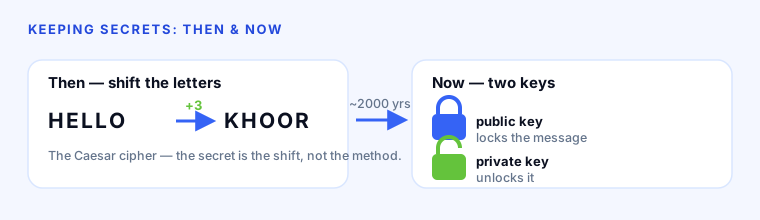
Every cipher so far shared one flaw: sender and receiver needed the same secret
key, which somehow had to be exchanged in advance over a secure channel. For two
strangers on the open internet, that is impossible.
In 1976, Whitfield Diffie and Martin Hellman published an idea that sounded
absurd — a way for two parties to agree on a shared secret in public, where an
eavesdropper hears everything and still cannot compute the secret. Soon after, RSA
gave each person a public key to lock messages and a private key to unlock them.
Cryptography's secrecy no longer depended on a pre-shared secret, but on
mathematical problems that are easy to compute forwards and effectively impossible
to reverse.
That single shift turned cryptography from a tool of spies into the foundation of
e-commerce, messaging and the web. Every padlock in your browser is public-key
cryptography at work — the direct descendant of Diffie and Hellman's impossible-
sounding idea. (Educatifu's Cyber Security track lets you play with both the hashing
and the key exchange behind it.)