
Educatifu
Open menu

A Short History of Quantum Computing

Why a computer built on the strange rules of the quantum world could crack codes and simulate molecules that no ordinary machine ever will — and why building one is one of the hardest engineering problems of our time.

Introductoryby Educatifuquantumhistory

An ordinary computer, however fast, works the way the machine in A Short History of the Bit does: everything is a 0 or a 1, and it does one definite thing at a time. A quantum computer plays by different rules — the rules that govern atoms and particles — and those rules are so strange that they let it do things no classical machine can. This short book explains what a quantum computer actually is, what it could do, and why, decades after the idea appeared, building a useful one remains so fiendishly hard.
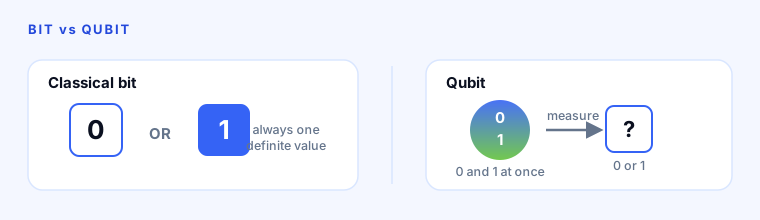
A classical bit is always either 0 or 1; a qubit is a superposition of 0 and 1 at once, and settles on a single 0 or 1 only when it is measured.

The one idea everything rests on: a qubit is 0 and 1 at once — until you look.

1. The trouble with very small things

At the scale of atoms, the world stops behaving like the one we see. A particle can be in a superposition — a blend of possibilities at once — and only settles on a definite state when it is measured. Two particles can become entangled, so that measuring one instantly tells you about the other, no matter how far apart they are; Einstein famously distrusted this "spooky action at a distance".

For most of the 20th century this quantum weirdness was physics, not computing. Then, in the early 1980s, Richard Feynman pointed out that a normal computer is hopeless at simulating quantum systems — the maths explodes too fast — and suggested building a computer that was itself quantum. A few years later David Deutsch described what a universal quantum computer would look like. A new field was born.

2. From bit to qubit

The heart of the idea is a new kind of bit: the qubit. A classical bit is either 0 or 1. A qubit can be in a superposition of both at once — not "somewhere in between", but genuinely a weighted combination of 0 and 1 until you look.

The catch is measurement. The moment you read a qubit, the superposition collapses to a single 0 or 1, at random, with probabilities set by the blend. So you cannot simply "read out all the answers". The entire art of quantum computing is arranging things so that, when you finally measure, the answer you want is overwhelmingly the one you get.

3. Two superpowers: superposition and entanglement

Put many qubits together and superposition compounds. Where 3 classical bits hold one of 8 possible values, 3 qubits can hold a superposition across all 8 at once — and n qubits span 2ⁿ possibilities. That exponential growth is where the promise of raw power comes from.

The second superpower is entanglement. Entangled qubits behave as a single linked system rather than independent parts, and a quantum algorithm choreographs these correlations. It is the combination — superposition to explore, entanglement and interference to combine the possibilities so wrong answers cancel out and right answers reinforce — that gives a quantum computer its edge.

4. Why it isn't just "trying everything at once"

It is tempting to say a quantum computer "tries all answers in parallel". That is the popular myth, and it is misleading. The superposition does hold every possibility, but measurement gives you only one, at random — so a naive approach gives you no more than a lucky guess.

The genius of a real quantum algorithm is interference: like ripples on a pond meeting crest-to-trough, the maths is engineered so the paths leading to wrong answers cancel each other out, while the paths leading to the right answer add up. You do not get the answer for free; you get it because the algorithm bends the probabilities in your favour before you look.

5. The algorithms that started a field

Two results in the 1990s turned quantum computing from curiosity into a global race.

In 1994 Peter Shor found a quantum algorithm that can factor large numbers efficiently. That sounds abstract until you remember that the security of RSA — much of the encryption protecting the internet — rests precisely on factoring being too slow for classical machines. A large enough quantum computer would break it.

Two years later Lov Grover found an algorithm that searches an unsorted list quadratically faster than any classical method. Shor's algorithm proved quantum computers could do something genuinely, dramatically better; Grover's showed the advantage was general, not a one-off.

6. Building a real machine

Here is the hard part. Qubits are exquisitely fragile. The faintest heat, vibration or stray field disturbs them and the delicate superposition decoheres into useless noise. Real devices are cooled to near absolute zero and shielded obsessively, and even then their qubits last only fractions of a second.

Researchers build qubits in competing ways — tiny superconducting circuits (IBM and Google), individual trapped ions held in electromagnetic fields, and others. In 2019 Google reported a task its quantum chip did faster than the best supercomputers could, a milestone it called "beyond classical". But today's machines are what physicist John Preskill named NISQ — Noisy Intermediate-Scale Quantum: enough qubits to be interesting, too much noise to be reliable. The great open challenge is quantum error correction, which spreads one stable "logical" qubit across many noisy physical ones — and needs far more qubits than anyone has yet built.

7. What it will and won't do

A quantum computer is not a faster laptop. For browsing, spreadsheets or most everyday software it offers nothing; classical machines will keep doing that work. Its power is narrow and deep — it shines on specific problems with the right structure.

The likely prizes are simulating molecules and materials (its original purpose — designing drugs, catalysts and batteries by modelling quantum chemistry directly), certain optimisation problems, and, ominously, breaking today's public-key cryptography. That last threat is why the world is already rolling out post-quantum cryptography — new codes designed to resist quantum attack — long before a code-breaking quantum computer exists.

When a truly useful machine arrives — years or decades away, no one can say for certain — it will not replace the computer on your desk. It will sit beside it, a specialist tool for a handful of problems that happen to be shaped like the universe itself. Understanding which problems those are, and why, is the real reason quantum computing is worth learning now.

Sources & further reading

  1. [1]Quantum computing — Wikipediaen.wikipedia.org
  2. [2]Qubit — Wikipediaen.wikipedia.org
  3. [3]Shor's algorithm — Wikipediaen.wikipedia.org
  4. [4]Quantum entanglement — Wikipediaen.wikipedia.org
  5. [5]Post-quantum cryptography — Wikipediaen.wikipedia.org

← All books

Bring us the problem, not a perfect specification

Tell us what needs to change, who it affects and any important deadline. We will review the context and reply with useful next questions.

  1. 01Share contextDescribe the workflow, constraint or risk.
  2. 02Clarify togetherWe identify missing facts and useful options.
  3. 03Choose a startAgree a focused assessment or delivery step.
Start a conversation