
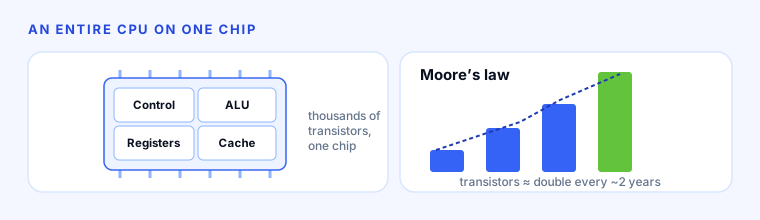
An entire CPU — thousands of transistors — shrunk onto a single chip, and shrinking further every couple of years.
In November 1971, Intel released the 4004, the first microprocessor sold commercially. It packed an entire central processing unit — some 2,300 transistors — onto a single fingernail-sized sliver of silicon. It had been designed, almost as a side project, to run a Japanese desktop calculator.
Why it mattered
Until then, a computer's "brain" filled circuit boards, cabinets, or whole rooms. Putting the CPU on one mass-produced chip made real computing power cheap, small, and reliable enough to embed almost anywhere.
That single shift unleashed the microcomputer and then the personal computer, and today puts processors in phones, cars, appliances, and toys. It also set the tempo the whole industry has run to ever since — captured by Moore's law, the observation that the number of transistors on a chip roughly doubles every couple of years, so each new generation arrives faster and cheaper than the last.