
In 1936, more than a decade before the first electronic computer, the British mathematician Alan Turing published On Computable Numbers. To answer a question in pure logic, he imagined a machine: an infinite paper tape, a head that reads and writes one symbol at a time, and a tiny table of rules. This Turing machine was never meant to be built — it was a thought experiment.
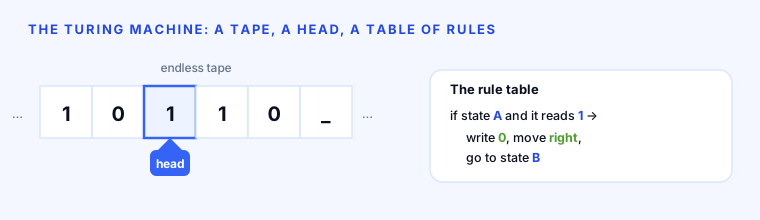
A head reads and writes one cell at a time on an endless tape, following a tiny table of rules — enough, in principle, to compute anything computable.
Why it mattered
That thought experiment turned out to define computing itself. Turing showed that a single universal machine, given the right instructions on its tape, could imitate any other such machine — the theoretical seed of the general-purpose, software-driven computer, where one device runs endless different programs.
He also proved the opposite: some problems (most famously the halting problem — deciding whether an arbitrary program will ever stop) cannot be solved by any machine at all. So the same 1936 paper drew both the map of what computers can do and the fence marking what they never will. Every real computer since is, in a precise sense, an approximation of Turing's imaginary one.