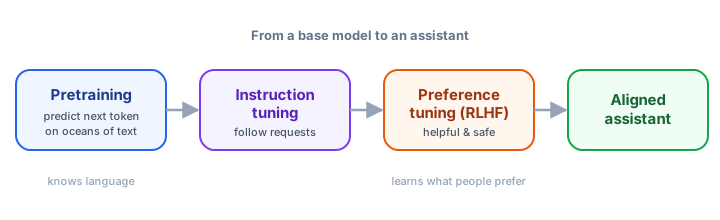
The model that comes out of pretraining is called a base model. It is an extraordinary next-token predictor and a poor assistant. Ask it a question and it may continue with more questions, because in its training data questions are often followed by more questions. It has capability without direction. Alignment is the process of pointing that capability at being genuinely useful.
Step 1: instruction tuning
First the base model is fine-tuned — trained further, at a low learning rate — on a curated dataset of instruction → response pairs written or vetted by people: "Summarise this email." → (a good summary.) This is still next-token prediction, but now on examples of the behaviour we want. The model quickly learns the pattern "when given a request, produce a helpful answer" instead of merely continuing the text. After instruction tuning it feels like an assistant.
Step 2: preference tuning (RLHF)
Instruction tuning teaches a correct answer; it does not teach which of several plausible answers people actually prefer. That is what preference tuning adds, classically via RLHF — reinforcement learning from human feedback:
- The model generates several candidate responses to a prompt.
- People (or a model trained to imitate them) rank the responses.
- A reward model learns to predict those human preferences.
- The assistant is optimised to produce responses the reward model scores highly.
The result is a model tuned toward being helpful, honest and harmless — better at following the spirit of a request, declining unsafe ones, and matching the tone people want. Newer methods such as DPO (direct preference optimisation) reach a similar place more simply, optimising directly on preferred-vs-rejected pairs without a separate reinforcement-learning loop.
Why this matters
Alignment is where a model's values and manners come from — and where much of the hardest, most consequential work in modern AI lives. The same base model can become a careful assistant or a reckless one depending entirely on this stage. Pretraining gives a model what it can do; alignment shapes what it will do.
You now have the whole pipeline end to end. The final lesson steps back from how models are built to how to use them well — their real limits, and the practical levers that matter in production.