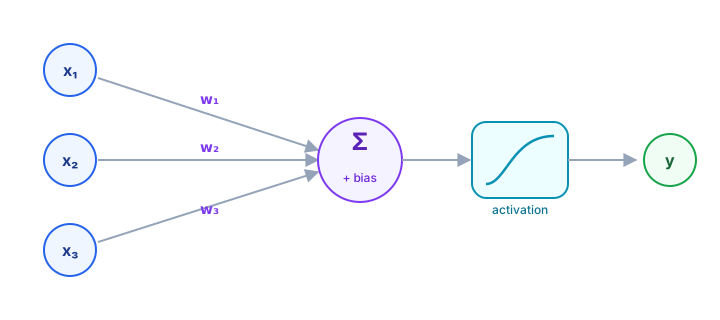
Artificial intelligence can feel like magic from the outside. It is not. Almost every modern AI system — image recognisers, recommendation engines, the large language models behind chat assistants — is built from one small computation, repeated at enormous scale. Learn that one computation and the rest of this track is just clever ways of combining it.
That computation is the artificial neuron.
The idea in one sentence
A neuron takes several numbers in, decides how much each one matters, adds them up, and produces a single number out.
That's it. The "deciding how much each matters" is where all the intelligence eventually lives.
The three ingredients
- Inputs — the numbers coming in. They might be pixel brightnesses, the words in a sentence turned into numbers, or the outputs of other neurons.
- Weights — one number per input, controlling its influence. A large weight means "this input matters a lot"; a weight near zero means "ignore this one"; a negative weight means "this input pushes the answer down".
- Bias — a single extra number added to the total. It shifts how easily the neuron responds at all, independent of any input.
The neuron multiplies each input by its weight, sums the results, and adds the bias:
sum = x1·w1 + x2·w2 + x3·w3 + bias
The activation function
If we stopped at the weighted sum, a neuron would only ever compute straight-line relationships — and stacking millions of them would still only give you a straight line. The activation function breaks that ceiling: it takes the sum and reshapes it.
- A step function fires a crisp
1when the sum crosses zero, and0otherwise — the original 1950s "perceptron". - A sigmoid slides smoothly from 0 to 1, so small changes in the inputs make small, differentiable changes in the output — which is exactly what lets a network learn later.
- A ReLU simply passes positive sums through and clamps negatives to zero — cheap, and the workhorse of modern deep networks.
See it move
Below is a live neuron. Drag the input and weight sliders and watch the weighted sum flow through the activation into the output. Try to make the output fire by making the weighted sum positive; then flip a weight negative and watch the same input start to suppress the neuron instead.
This one unit, wired to thousands of others, is the whole game. In the next lesson we connect several neurons into a layer, and a few layers into a network — the structure every deep-learning system shares.