One qubit in superposition is remarkable. Two qubits that are entangled are where quantum computing gets its real power — and its reputation for weirdness.
A shared state, not two states
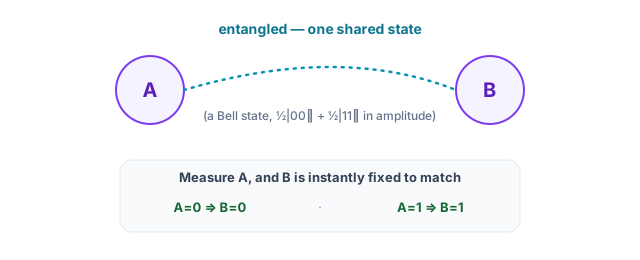
Normally, two qubits each have their own state. Entangled qubits do not: they share a single, inseparable joint state. The classic example is a Bell state, an even superposition of "both 0" and "both 1":
|Φ⟩ = ( |00⟩ + |11⟩ ) / √2
Read that carefully. The two qubits are either both 0 or both 1 — never one of each. But which of those two it will be is undecided until measured. Neither qubit has a value of its own; only the pair does.
Measuring one decides the other
Now measure just the first qubit. By the Born rule you get 0 or 1, each with 50% odds. But the instant you do, the second qubit is fixed to match — if you saw 0, it is now 0; if you saw 1, it is now 1 — even if the two qubits have been carried light-years apart. Einstein called this "spooky action at a distance", and it is completely real, confirmed in countless experiments.
No faster-than-light messaging
A natural worry: doesn't this send information instantly? It does not. The person holding the second qubit just sees a random 0 or 1; without a classical message telling them what you measured, they cannot tell their outcome was correlated with anything. Entanglement creates correlation, not communication — relativity is safe.
Why it matters for computing
Entanglement is a resource. It lets a quantum computer build joint states whose possibilities are linked in ways no set of independent bits can reproduce. Combined with interference — steering amplitudes so right answers reinforce and wrong ones cancel — entanglement is what separates a quantum computer from a machine that merely flips a lot of coins in parallel.
You now have the three pillars: superposition (a qubit is a blend of 0 and 1), measurement (reading it collapses that blend to one value), and entanglement (qubits can share a joint state). With these, the Core level can build the actual machinery — quantum gates and circuits — and then the algorithms that put it all to work.