Everything so far assumed qubits behave perfectly. They emphatically do not. This lesson is about the single hardest problem in the field — the reason a working quantum computer is so difficult to build that it has taken decades and still isn't done.
Decoherence: superposition is fragile
A qubit's power comes from holding a delicate superposition of amplitudes. But those amplitudes are destroyed by the faintest interaction with the outside world — a stray photon, a vibration, a tiny magnetic fluctuation. This leakage of quantum information into the environment is called decoherence, and it happens fast: today's best qubits hold their state for only microseconds to milliseconds. On top of that, every gate you apply is slightly imperfect, adding its own error. Run a long computation and errors accumulate long before you finish.
Why you can't just copy qubits
Classically, you fight errors with redundancy: store three copies of a bit and take the majority vote. That's impossible for qubits, because of two rules from Foundations:
- the no-cloning theorem says an unknown quantum state cannot be copied; and
- measuring a qubit to check it destroys its superposition.
So the classical trick is doubly forbidden. For a long time this made many doubt quantum computing was possible at all.
The breakthrough: quantum error correction
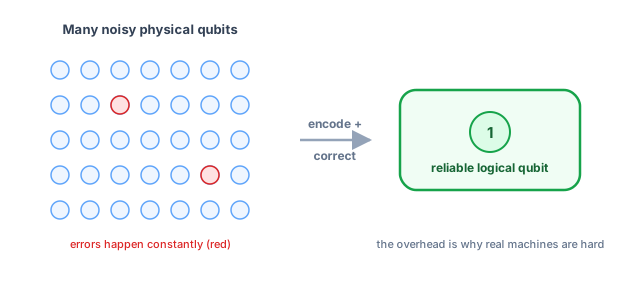
The escape is ingenious. Quantum error correction spreads the information of one logical qubit across many entangled physical qubits, then measures only carefully chosen combinations — the syndrome — which reveal whether and where an error occurred without revealing the data itself. You detect and fix the error while never learning (and so never collapsing) the protected state. Run this continuously and a logical qubit can, in principle, live indefinitely — even though its physical qubits are failing all the time. The diagram captures the idea: many noisy qubits in, one reliable qubit out.
The catch: overhead
Here is why timelines are measured in years, not months. The overhead is brutal — current estimates suggest roughly hundreds to a thousand physical qubits per logical qubit, and running Shor's algorithm on a real cryptographic key might need millions of physical qubits. Today's machines have hundreds to low thousands of physical qubits, and only a handful of shaky logical ones. Closing that gap — reaching fault tolerance, where error correction outpaces the errors — is the grand engineering goal of the entire industry.
With the physics understood, the next lesson looks at how people actually build these fragile qubits, and where the technology really stands today.