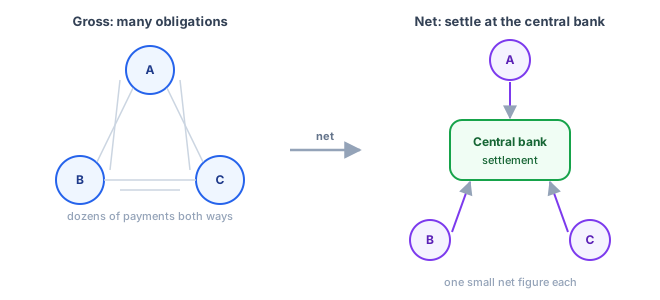
Between a handful of big banks, millions of payments flow every day in every direction. Settling each one individually — moving real reserves for every single transfer — would demand staggering amounts of cash sitting idle. The system's answer is two distinct steps that the previous lesson introduced: clearing and settlement.
Clearing: collect and net
Clearing is the process of collecting, matching and totalling the payments between banks before any money changes hands. Its superpower is netting. Suppose across a day:
- Bank A owes Bank B $100m, and Bank B owes Bank A $95m.
Rather than move $195m in two directions, clearing nets them: Bank A simply owes Bank B $5m. Multiply that across every pair of banks and a torrent of gross obligations collapses into one small net position per bank — often a tiny fraction of the gross flow. That is why the diagram's left side (many arrows) becomes the right side (a few small ones).
Settlement: make it final
Settlement is the moment those net positions are actually paid and the obligations legally discharged — the payment becomes final and irrevocable. The critical question is always in what money? The answer, for the amounts that matter, is central-bank money: balances banks hold in reserve accounts at the central bank.
Why the central bank sits at the top
Commercial-bank money is a claim on a bank — and banks can fail. Central-bank money cannot; it is the ultimate settlement asset with no credit risk. So the banking system is a hierarchy: you hold money at your bank, your bank holds reserves at the central bank, and final settlement between banks happens by moving those reserves. When Bank A settles with Bank B, the central bank simply debits A's reserve account and credits B's — the same double-entry ledger idea from the first lesson, now at the apex of the system.
The shape of the system
Put the Foundations together and the architecture of money comes into focus:
- money is a ledger — balances, recorded as double entries;
- payments move value between ledgers through instruction, clearing and settlement;
- clearing nets the flood of obligations down to manageable net figures;
- settlement in central-bank money makes them final.
Everything more advanced — card networks, RTGS systems, cross-border correspondent banking, real-time rails, and the newer world of stablecoins and tokenised settlement — is a variation on these foundations, trading off speed, cost, reach and risk. That is the plumbing of modern money, from the ground up.