Here is a fact that surprises almost everyone the first time they hear it: most money is not created by the government or the central bank. It is created by ordinary commercial banks, out of nothing, every time they make a loan. To see how — and why that's not a scandal but the design — you need the money hierarchy.
Money is layered
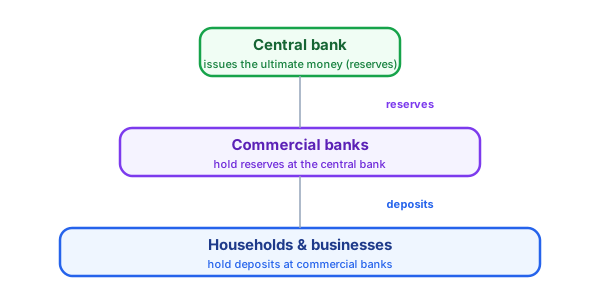
Not all money is the same "level" (see the diagram):
- Central-bank money (reserves) sits at the top. The central bank issues it, and it is the ultimate, risk-free settlement asset — the money banks use to settle with each other (from the Foundations settlement lesson).
- Commercial-bank money (deposits) sits below. Your bank balance is not central-bank money — it is a promise from your bank to pay you. It's a claim on a commercial bank, one tier down.
- Households and businesses hold those deposits.
Each tier holds money issued by the tier above. This layering is why the settlement hierarchy from Foundations exists at all.
Banks create money when they lend
Now the surprising part. When a bank grants you a loan, it does not hand over someone else's savings. It simply credits your account — typing a new deposit into existence — and records a matching loan as an asset. Two new ledger entries (exactly the double-entry from the very first lesson): a new deposit (money) and a new loan. The money didn't exist a moment before. When the loan is repaid, that money is destroyed again.
So the bulk of the money supply is commercial-bank money conjured by lending — not notes printed by the central bank. (The old "banks lend out a fraction of deposits" story is a simplification; modern central banks describe it as banks creating deposits when they lend, constrained by capital, regulation and profitability.) Post a couple of transactions in the ledger widget again and notice: every balance is somebody's asset and somebody else's liability — including the money in your pocket.
Why the central bank still rules
If banks create most money, what does the central bank do? It sits atop the hierarchy and sets the price and availability of reserves — the interest rate. By making reserves cheaper or dearer, it influences how much banks are willing to lend, and therefore how much money gets created, steering inflation and growth. It is also the lender of last resort: in a crisis, it can supply reserves to stop a solvent bank from failing merely because everyone wants their deposits back at once. The central bank doesn't create most of the money — it governs the system that does.
This layered, interconnected structure is powerful and fragile at once. When one part wobbles, the connections can transmit the shock system-wide — which is the subject of the next lesson: market infrastructure and systemic risk.